
The last few weeks have been a strange mix of writing, parenting, and building a desk from old decking boards.
Writing and editing are still moving forward, although perhaps not as quickly as I originally planned. I had hoped to have another blog post published already, but life has its own rhythm when you are at home with a toddler.
Time becomes a different sort of creature in that situation. It rarely appears in long, quiet stretches the way it used to. Instead, writing happens in fragments — when the house is quiet at night, during naps, or in those brief moments where our toddler decides books are more interesting than climbing furniture. Although a quiet child is more dangerous than a noisy one. It is not always the most efficient way to work, but the words still move forward.
Since the COVID shutdowns, work moved to the end of the dining table, and most of my writing has taken place there. At first, it seemed like a simple temporary solution. Bought a trackball mouse, a NUC computer—one of those little boxes with the power of a laptop—and kept my old monitor that almost spanned the width of the table.
Over time, though, the dining table began to feel less like a writing space and more like an eyesore, and with our girl, we needed the family room space.
Eventually, it became clear that the problem was not the table. The problem was that the space itself had never been given the chance to live and breathe.
So I decided to build something new.
Turning Old Decking into a Desk
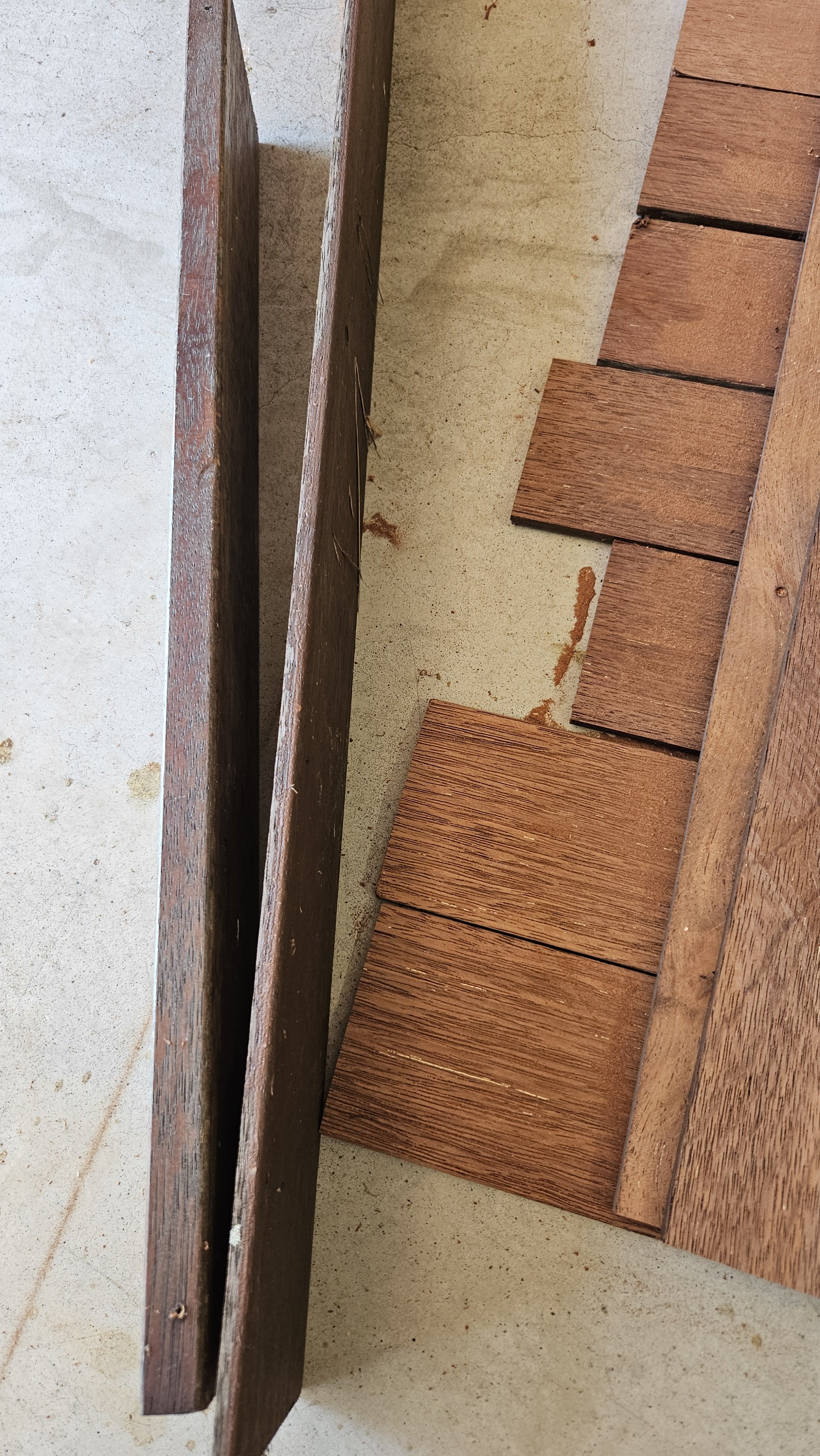
decking boards ripped thinner
Rather than buying a desk top, I started with something I already had: a stack of old decking boards.
The timber had been sitting around for years. Weathered, full of screw holes, and clearly showing the marks of its previous life outside. Still, the wood itself was solid. Too good to throw away.
The first step was cutting the boards through their thickness. Splitting them down gave me the thin boards to layer them in a 3-ply.
With a little work, what had been rough outdoor decking suddenly became usable material again.
Once the boards were prepared, the layout process began. Each piece had to be measured, rotated, and arranged so that the grain patterns worked together and the joins would remain strong once glued.
The base of the desk top was built as a two-ply layer. Boards were laid out across the frame and glued together to form a stable foundation. This glued layer would provide the strength and structure needed to support everything above it.
Once the base layer had cured, the top layer was prepared. Each piece was trimmed again to remove the old screw holes and any remaining damaged sections. Slowly, board by board, the surface began to take shape.
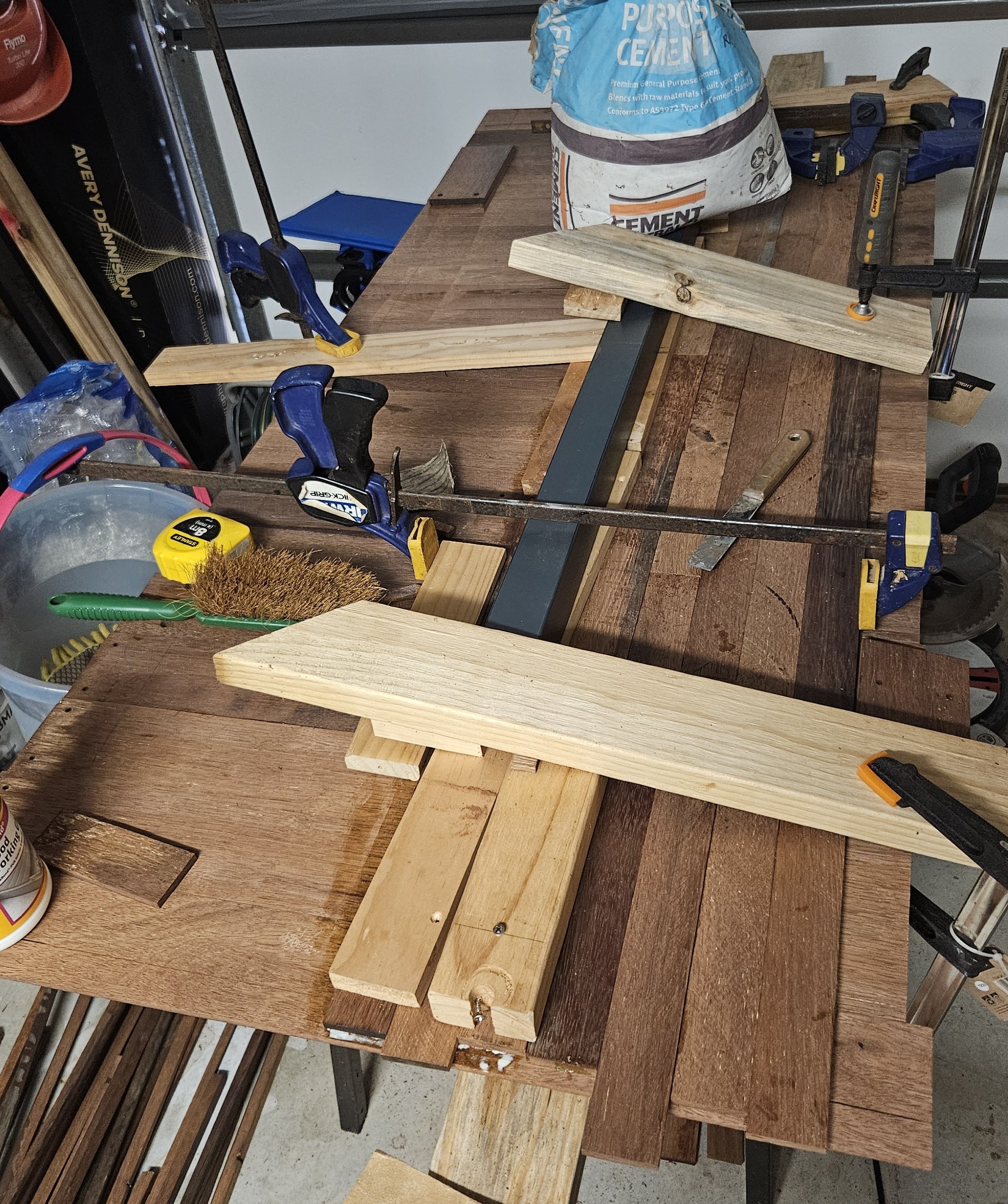
The top layer being glued down in sections
There is something satisfying about this stage of the process. The work is repetitive and careful, but you can see the transformation happening. What began as scattered timber slowly becomes a single surface.
After the final boards were glued down, the entire desk was sanded and finished. The marks of the timber's previous life are still there if you know where to look, but they now belong to something new. I even left a few knot marks or interesting points on the upper layer.
What used to be outdoor decking is now the surface where new stories are written.
As it turns out, it might have been cheaper to buy a table top than make it, but I had the timber my wife kept asking me to do something with.
Building Stories the Same Way
Working on the desk made me think about how similar the process is to writing.
A story rarely begins as a finished structure. It begins as fragments — notes, rough ideas, scenes that may or may not survive the editing process. Much like reclaimed timber, the raw material often looks messy at first.
The early stages are about structure; finding the pieces that belong together and discarding the ones that don’t. Trimming away the damaged parts and gluing can strengthen the foundation, so the final shape can hold its weight.
Only after that work is done does the surface start to look smooth.
Writing and woodworking share that same patience. You cannot rush either one without seeing the results later.

almost complete
Writing Progress
Despite the unpredictable schedule of life at home, the writing itself continues to move forward.
Editing is ongoing, notes are expanding, and several upcoming blog posts are slowly taking shape.
The first explores payoff in storytelling and how narrative rhythm developed across the twentieth century. Early filmmakers were experimenting with tension, timing and visual language long before modern storytelling rules were established. Those early experiments gradually shaped the structure we recognise today; a careful balance of setup—tension—release.
The second topic is quite different. It looks at the slow erosion of institutions and ideas and how those patterns appear both in history and fiction. The more I research that subject, the clearer it becomes that it deserves more than a single article. What started as a simple post is now shaping up to be a short series examining how gradual cultural shifts can change the direction of entire societies.
Stories often mirror those patterns in smaller ways, which is part of what makes the subject so interesting to explore from a writing perspective.
A Glimpse of the Next Series
There is also another piece I plan to share in a future post.
While studying at university, I wrote a short assignment that explored the background of one of my characters. At the time, it was simply an exercise—a small piece of writing intended to explore motivation and character development.
But the idea refused to stay small.
What began as a short assignment gradually expanded into something much larger. The character's past began to take shape, revealing events that influenced the choices he would later make in the main story.
That small piece of coursework eventually grew into the opening chapter of the next series, rewriting the opening of the entire story and making it better. This new opening gave way to a greater understanding of my main character and allowed me to explore his pained past and the reason for doing the things he does.
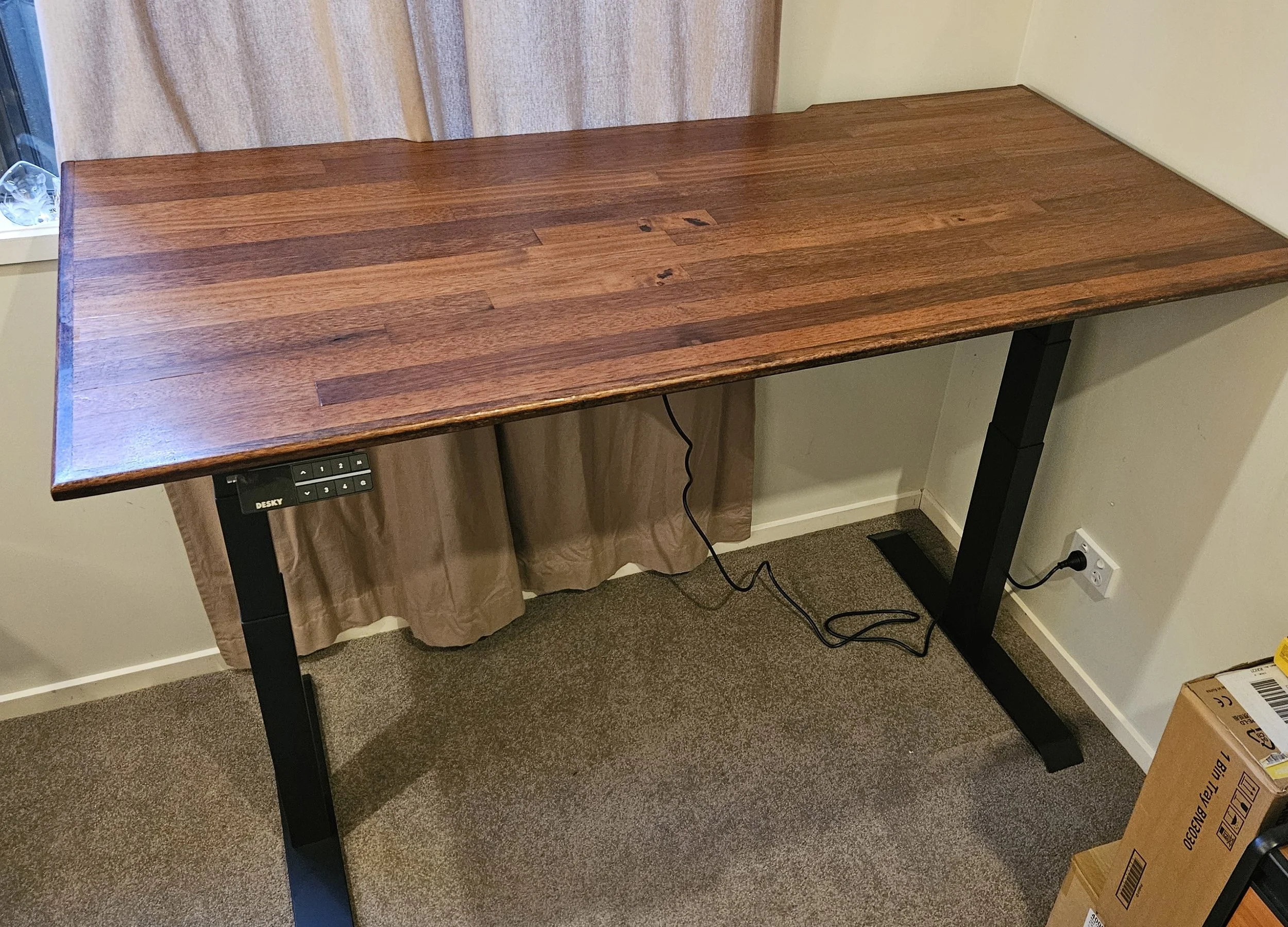
finished desk in its new home - I have my monitor on an arm and working here today
In an upcoming post I will share the opening part of that chapter as a preview.
Sometimes the smallest ideas end up becoming the most important pieces of a story.
Back to the Words
For now, the sawdust has settled, the desk is finished, the keyboard finally has a home, and the dining table has been fully reclaimed for dinner once again.
And the stories continue to grow.
Which means it is time to get back to the words.
If you haven’t already, check out the books tab to see what’s been released and what’s coming.
