
Dystopian State: Demoralisation — Can You See It?
Part One of Four
Yuri Bezmenov had the answer, and science fiction figured it out too.
Before We Begin: A Note on What This Is
I want to be upfront about something before we get into it. This four-part series is based entirely on the work of Yuri Bezmenov — a KGB defector who, in a series of interviews during the 1980s, described a framework for subverting a nation from within. I'm not a political analyst, a historian, or a security expert. I'm a science fiction writer from Brisbane who fell down a very deep rabbit hole and didn’t climb back out.
Everything Bezmenov described, he framed in the context of Cold War geopolitics. I'm not applying it to any current events, any government, any movement, or anything happening in the real world today. That's not what this is. What grabbed me, and what I can't stop thinking about, is how precisely the fiction we already love maps onto the framework he laid out. Writers like Ray Bradbury imagined these patterns decades before most of us had even heard of Bezmenov. That parallel is what I want to explore.
Think of this as a reading of the films and not a reading of the news. Consider it firmly in the territory of literary and narrative analysis.
If you're looking for political commentary, you've taken a wrong turn somewhere. The exit is to the left.
The four stages Bezmenov described are: Demoralisation, Destabilisation, Crisis, and Normalisation. There will be one post for each. This is Part One.
How I Ended Up Here
A month ago, in my desk-building post, I mentioned that I'd been researching something that started as a single blog idea and quietly turned into a series. This is that series. And yes, it grew out of a research spiral that started well after midnight, which is, in hindsight, exactly the sort of environment where you should not be watching KGB defector interviews. Lesson not learned, but my mind expanded.
I'd come across footage of Bezmenov through a documentary while researching something else. What stopped me cold wasn't the Cold War context; it was how precisely the patterns he described mapped onto science fiction I already loved. Films I'd watched as a teenager and beyond. Stories I'd analysed as a writer and the Bradbury adaptation sitting on my shelf. It felt like finding a key that fit a lock you'd forgotten you had.
So, I went deeper. I watched a few films again with fresh eyes and chose these examples to dissect (the subject of) demoralisation of a fictional country. I read parts of the transcripts, I took more notes than I'd like to admit at one in the morning. And eventually Amanda looked over my shoulder and said something like, "Is this going to be another one of those things that keeps you up until two?" Hint, it was.
Stage One: Demoralisation
So, what does "demoralisation" actually mean?
My first instinct was to think of it the way you'd use the word in everyday conversation — low morale, a team that's given up, that sort of thing. But Bezmenov meant something more specific, and honestly, more unsettling than that.
He described demoralisation as the process by which a population loses its ability to evaluate reality accurately. Not through ignorance; ignorance you can fix by handing someone a book. This is something deeper.
Think of it as the slow erosion of the very tools people use to think: their education, their shared cultural memory, their sense of what's true and what matters. Once those are gone, you can show someone the truth, and it literally won't register. The architecture of their thinking has been changed.
He said it takes at least 15 to 20 years, because that's how long it takes to educate a full generation of students. You need to wait for the people who remember how things used to be, a generation with a point of comparison, to retire, or move on, or simply stop being heard. Then the institutions they built get handed to people who've never known anything different. And that's when the job is done.
The three main targets, according to Bezmenov, are education, the media and information environment, and perhaps most powerfully, a society's moral and cultural self-image. Chip away at all three, and you end up with a population that doesn't just fail to resist what's happening; it can't even name it.
Now, here's where it gets interesting. Because science fiction got there first.
Equilibrium (2002) — demoralisation as medicine
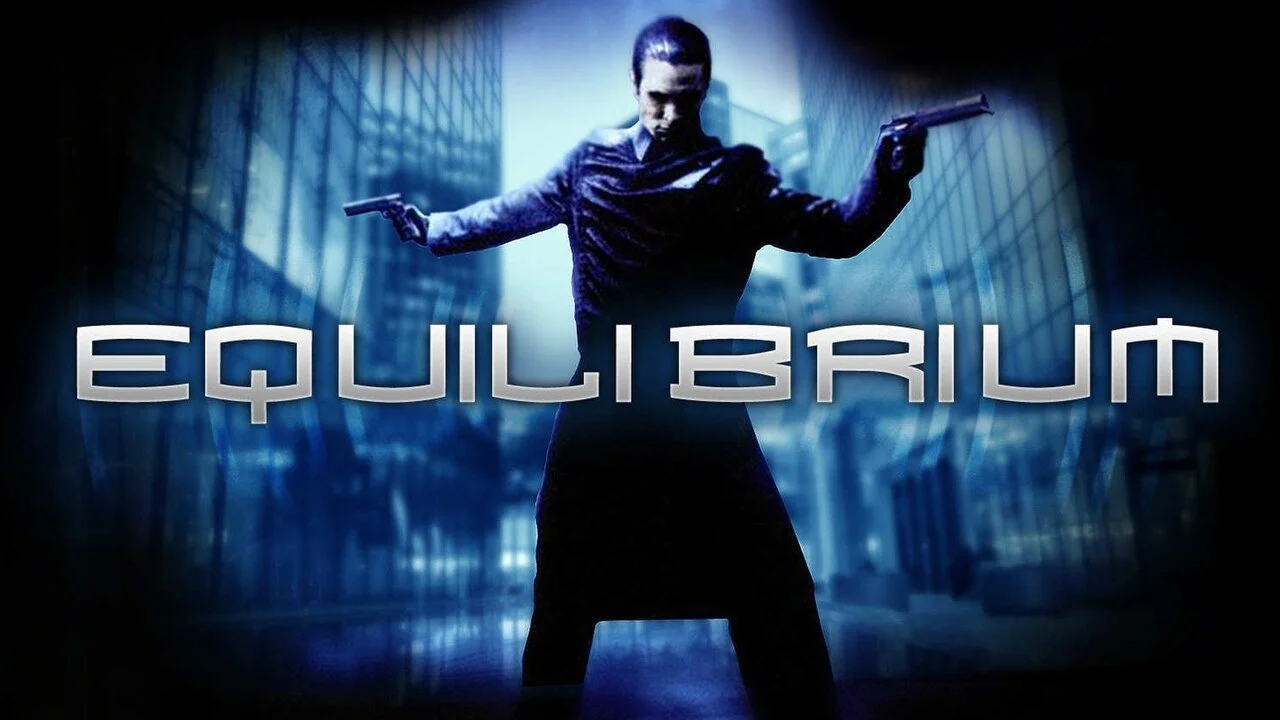
Before he was Batman
If you haven't seen Equilibrium, it's one of those films that didn't get the attention it deserved on release but has quietly built a following. Set in a future totalitarian state called Libria, it imagines a society that has eliminated human feeling as a public health measure. Every citizen takes a daily injection of a drug called Prozium that suppresses emotion. Art, music, poetry, anything that might stir something in you, is outlawed. The enforcement arm, the Grammaton Clerics, hunt down and destroy what they call "sense offenders."
When I first watched this film, it registered mainly as a stylish action movie — and it is a stylish action movie, let's be honest — that shoot-out in the dark, wow. But coming back to it through the lens of Bezmenov, something else entirely clicked into place.
The Bezmenov Connection
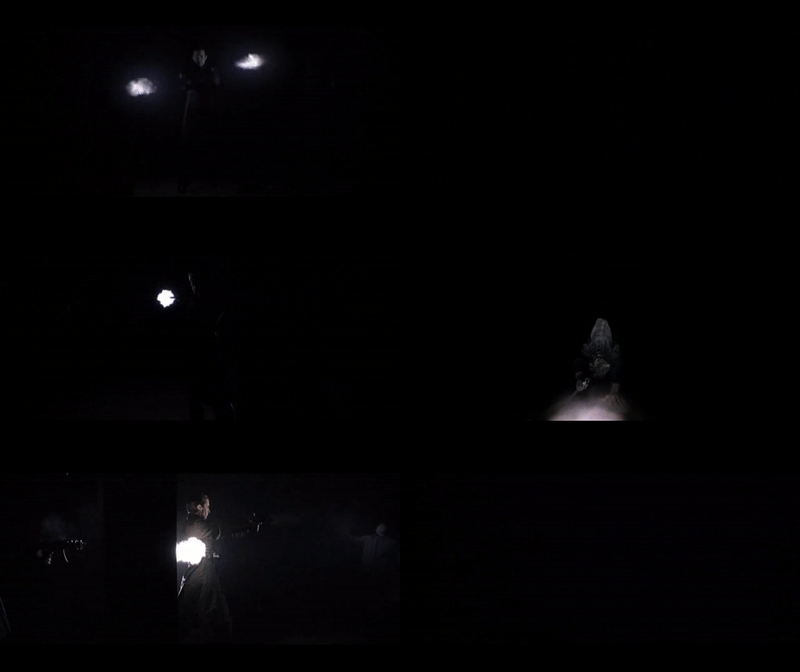
The scene is filmed like this
Equilibrium (2002, dir. Kurt Wimmer)
What makes Equilibrium so relevant here isn't the drug itself — it's the logic behind it. The regime doesn't tell citizens they're being controlled. It tells them they're being protected. The suppression of feeling is framed as a rational response to a real problem of war, violence, and human suffering. The Clerics aren't thugs. Instead, education has made them true believers and professionals who are convinced their actions are necessary. The demoralisation of Libria doesn't look like oppression, it looks like progress. And the citizens don't feel demoralised, they feel stable, they feel normal. That gap between what's actually happening and what it feels like from the inside is exactly what Bezmenov was describing.
This is the part that really stuck with me. The most effective demoralisation, Bezmenov argued, never announces itself. It works through schools, broadcasters, cultural authorities, the institutions people already trust. The population doesn't feel like things are being dismantled; it feels like things are being improved.
Fahrenheit 451 (1966) — burn the comparison
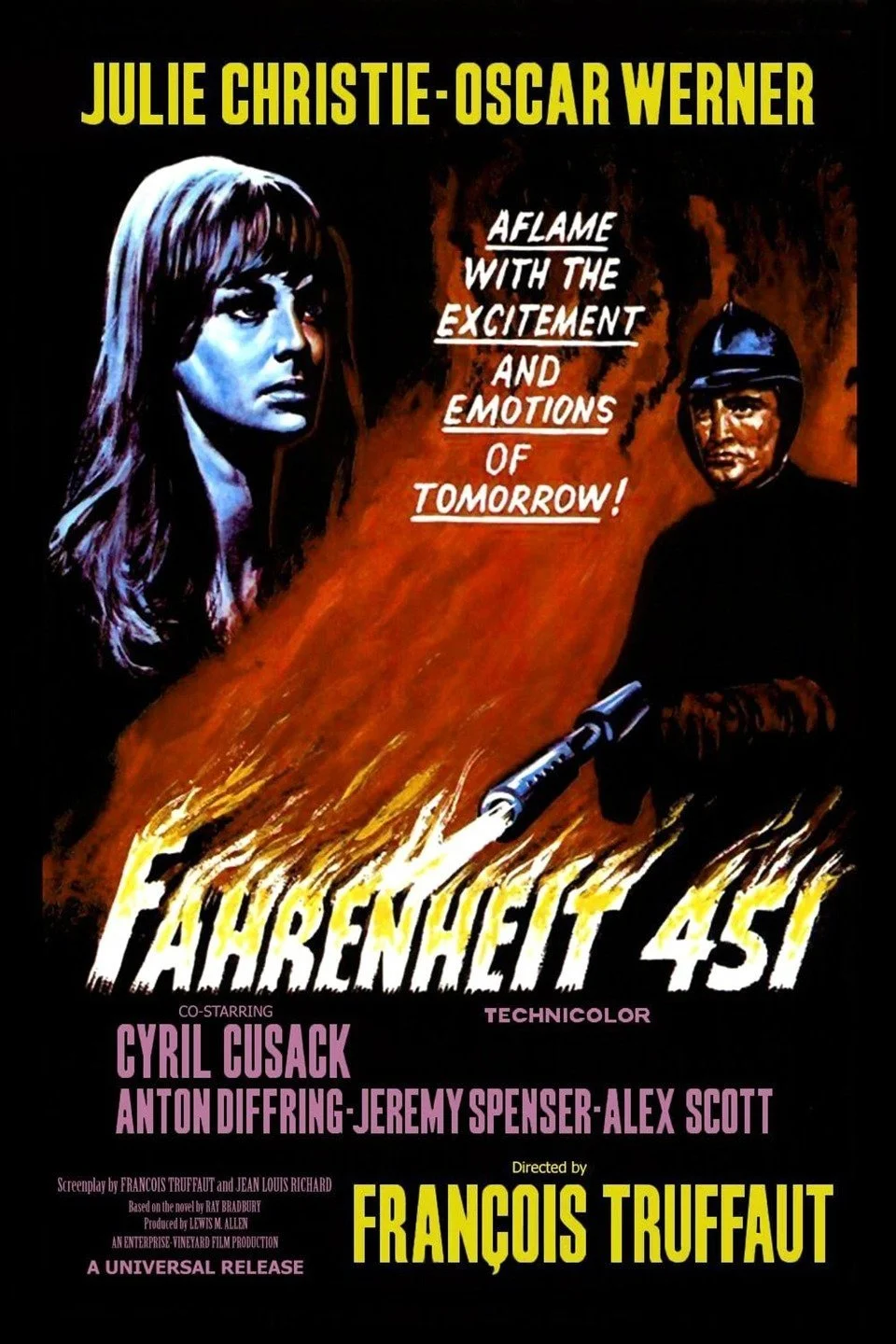
Truffaut's adaptation of Ray Bradbury's novel takes a slightly different angle, and it's one I find even more interesting when you hold it up against Bezmenov's framework. In this world, books aren't suppressed because the regime fears specific ideas. They're burned because books allow people to compare. They create a point of reference outside the present moment, outside the official story. And a population with no point of reference has nothing to measure its situation against.
The Bezmenov Connection
Fahrenheit 451 (1966, dir. François Truffaut)
The detail in Truffaut's film that I keep coming back to is this: the firemen aren't unhappy. The protagonist Montag begins the film as a dutiful professional who takes quiet pride in his work. The burning isn't experienced as destruction; it's experienced as maintenance. Keeping things clean and people comfortable. When the horror arrives, it doesn't come from a dramatic reveal; it comes from a slow, private accumulation. There is a growing sense that something important has been removed from the world, and that almost no one noticed it go.
That's such a precise image of what Bezmenov described. Not a bang, but a quiet handover.
Bezmenov was very specific about cultural memory and about why it matters so much. He called it the immune system of society. A population that knows its own history, that has access to literature and philosophy and the record of past mistakes, keeps the ability to name what's happening to it. It has vocabulary and a precedent of time. By simply not passing it on, the inheritance is gone within a generation. History and culture are erased.
“A person who is demoralised is unable to assess true information. The facts tell nothing to him. Even if I shower him with information, with authentic proof — he will refuse to believe it.”
They Live (1988) —obey, consume, repeat
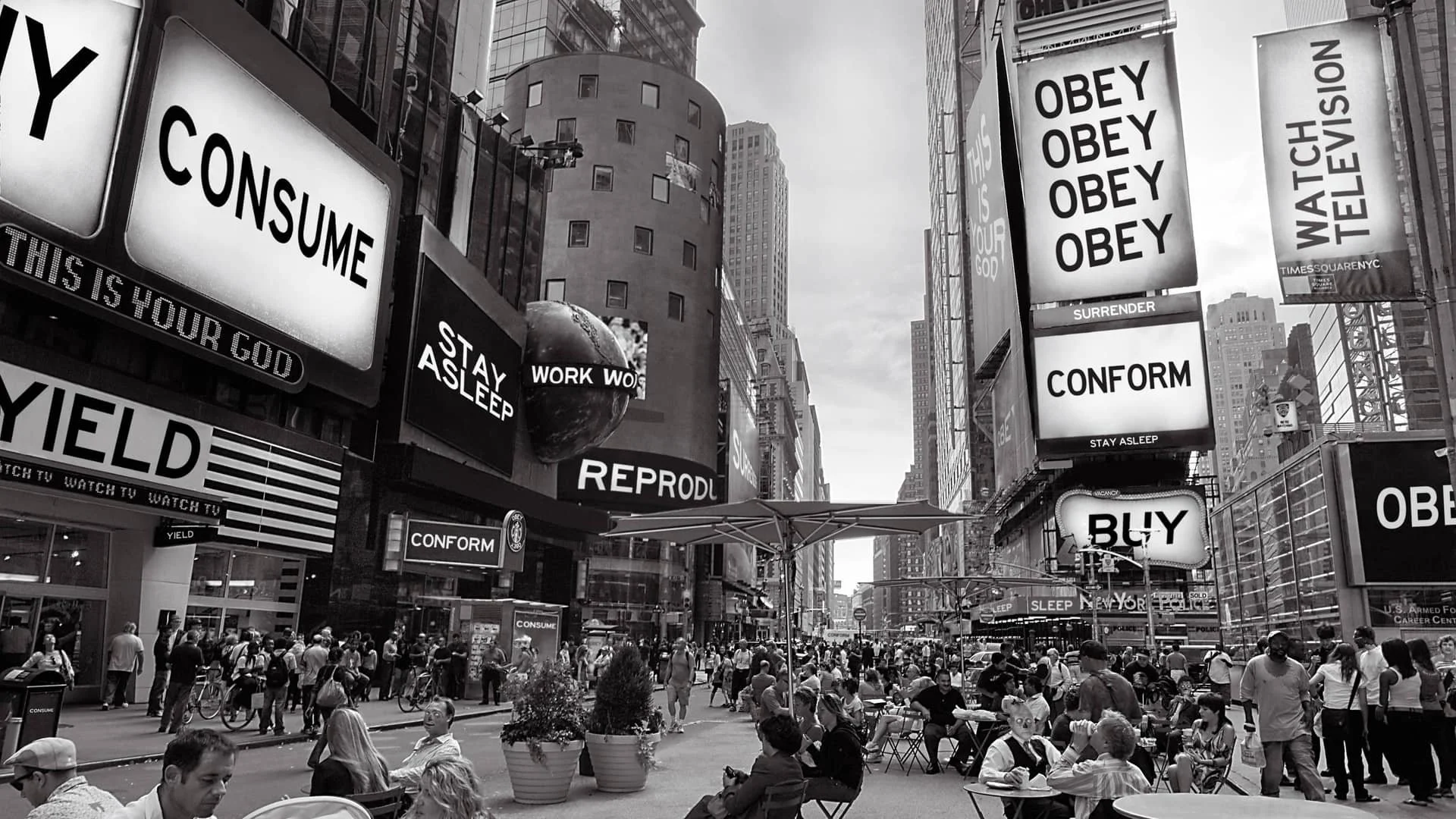
New York city while wearing the sunglasses
John Carpenter's They Live is one of those films that gets dismissed as a B-grade movie and then lodges in your brain permanently.
When I first watched it, I saw what the critics told me to see — bad writing, bad acting, passable action, and sardonic wit. Which, now that I think about it, is a very They Live way to have watched They Live.
(Rowdy) Roddy Piper plays Nada, a drifter who finds a pair of sunglasses that strip away the signal blanketing everyday life. Without them, the world looks normal: billboards, magazines, television, people going about their business. With them, every surface reveals its actual message. OBEY. CONSUME. DO NOT QUESTION AUTHORITY. NO INDEPENDENT THOUGHT. The control isn't hidden exactly. It's just broadcasting on a frequency nobody can tune into without help.
The Bezmenov Connection
They Live (1988, dir. John Carpenter)
What makes They Live the most precise illustration of Stage One is that the population isn't suffering. There are no Clerics, firemen, or secret police kicking down doors. Nobody is being marched anywhere. People are shopping, working, watching television, and they feel completely fine about it. The demoralisation is ambient. It hums along in the background of ordinary life, using the infrastructure people already trust and interact with every day. That's the detail Bezmenov kept returning to: the successfully demoralised population doesn't know it's been demoralised. Life feels like a normal Tuesday.
Then there's the alley scene, which is hard to forget. Nada tries to get his friend Frank to put on the glasses, but Frank refuses. What follows is several minutes of two men genuinely fighting over a pair of sunglasses. First watch, it was baffling to see this, but on a second watch through using this lens, it’s something else entirely. It’s the most accurate over-dramatisation of Bezmenov’s central claim I’ve seen. Presenting someone with the truth isn’t enough. The resistance is something structural, something physical to overcome. You can lead a person to the glasses, but you can’t make them put them on.
What all three films get right

Watching these through the lens of Bezmenov's framework, what strikes me is how consistent the pattern is across three very different stories. In each case, the demoralisation isn't experienced as demoralisation by the people living inside it. It feels like safety, order, or simply normality. In each case, the tools of suppression are the society's own institutions, turned inward. And in each case, the people who've been demoralised aren’t cynical but genuinely convinced of the legitimacy of their situation.
That last point matters. Bezmenov wasn't describing a population of beaten-down people who know they've lost. He was describing people who are, in a specific sense, comfortable. They've been relieved of the burden of critical thought. They've been given a coherent story about the world. The discomfort only arrives when something punctures that story, if it arrives at all.
As a writer, I find myself obsessing over why certain stories work, why a scene becomes a meme, or a film gains its cult following twenty years later.
Part of this answer goes back further than any film on this list.
Yevgeny Zamyatin saw it first. Writing from inside the early Soviet system in 1920, before Bezmenov was born, he described a population that had been surgically relieved of imagination — people who felt stable, purposeful, and free. That novel became We (1924 – translated English version). It was suppressed in Soviet Russia until 1988. It quietly inspired Brave New World, then 1984, then the films on this watchlist. Fiction has a way of getting there first. The question worth sitting with is why we keep needing to rediscover the same thing.
Let me know in the comments if you think I missed something — though if Bezmenov is right, you may not be able to see it yet.
Up Next
In Part 2, we move on to Destabilisation. The patient work of Demoralisation is over. Now the economic, political, and social foundations begin to be actively targeted — and the population is exactly as vulnerable as it was designed to be.
Stage 1 Watchlist
Equilibrium (2002, dir. Kurt Wimmer)
Fahrenheit 451 (1966, dir. François Truffaut)
They Live (1988, dir. John Carpenter)
All images and representations belong to their respective creators and are used here for commentary and analysis.
